


How can we create the conditions in schools that give PD the best chance of having impact?
In previous articles, we looked at why professional development is something worth investing our time in and what it looks like when done well. Here we look at the conditions within which PD takes place.
Evidence suggests the conditions within which PD takes place are just as important as the quality of the PD itself. A school environment can mean that even the most well-designed PD is perceived as punitive or threatening and if this is the case, the impact of the PD will be significantly reduced, if not completely undermined.
Do school environments impact upon teacher development?
One of the most well-known studies which measures the impact of the environment on teacher development comes from Matthew Kraft and John Papay, in a study titled: Can Professional Environments in Schools Promote Teacher Development?
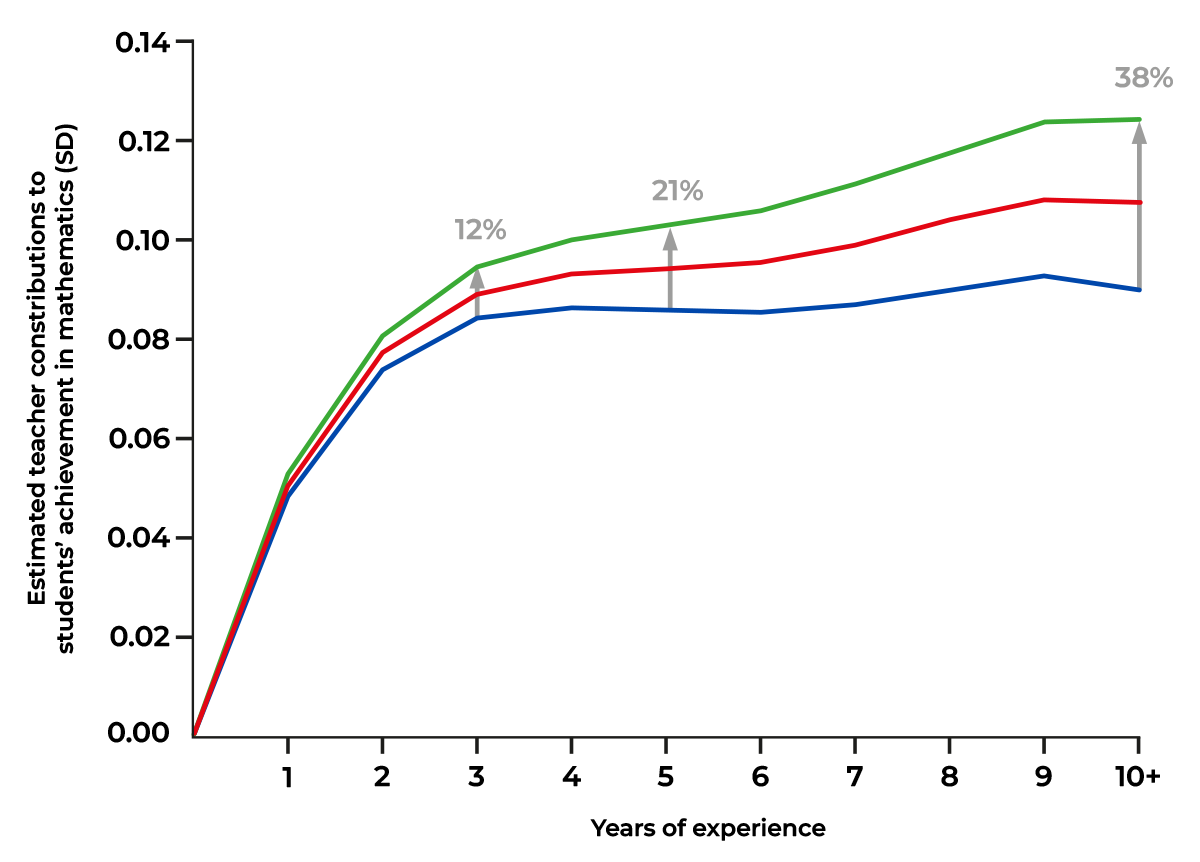
The answer is yes. They found that teachers working in more supportive professional environments improve their effectiveness more over time than teachers working in less supportive contexts’. The impact of this difference in effectiveness after 10 years equated to a 38% difference in effectiveness. Translated to impact on pupils, pupils who were taught by teachers in the strongest professional environments made between an extra week and an extra month’s progress every year.
The graph below demonstrates this impact. After 10 years, teachers working in the most effective professional environments (the green line) are 38% more effective than those working in the least effective (the blue line).
The fact that teachers improve at different rates in different types of schools is not especially surprising. Decades of research into organisational environments have demonstrated (and attempted to explain) differences in the productivity of workers as they go about their daily work. If we know that environments can make a difference, it is crucial to understand how. What exactly is it about the environment that leads to teachers having more impact on their pupils?
The features of strong professional environments
Kraft and Papy describe six features of strong professional environments:
- Consistent order and discipline: unsurprisingly, teachers who have to battle with poor pupil behaviour found their impact to be significantly compromised. The best environments were ones in which schools had clear and consistent approach to managing pupil behaviour which was strongly supported and enforced by leaders in the school.
- Opportunities for peer collaboration: evidence shows teachers get better faster when they have opportunities to work with and learn from their peers. The quality of this collaboration needs to be focussed on improving teachers instructional capabilities.
- Supportive principal leadership: the quality of principal leadership was of pivotal importance to the quality of the school’s environment. Kraft and Papy explain that principals are the ones who establish strong organisational supports and build growth-enhancing school-wide cultures, creating the foundations for the resulting culture across the school.
- Effective professional development: a significant body of literature points to the impact that high quality professional development can have on teachers’ impact. More recent research highlights the effective features of PD (the causal mechanisms, which we covered in blog two).
- A school culture characterised by trust: the importance of the environment within which teacher’s work cannot be underestimated. The environment needs to one which reflects a collective commitment to pupil achievement and be consistently characterised by openness, respect and strong mutual trust between colleagues.
- A fair teacher evaluation process which provides meaningful feedback.: effective teacher evaluation is a tricky business and what the paper is not advocating is accountability driven pay related performance evaluation. Instead, the evidence finds in favour of processes which involve observation of practice and feedback about that practice such that teachers have greater insight into their work.
Conclusion
The findings from the Kraft and Papy study are important for a number of reasons. Firstly, they show that improvement over time is possible, given the right conditions, and that the impact they can have long into their teaching career is significant. Second, the environment is with our control to influence, every minute of every day, there is no limit to the positive effect the environment can have. Finally, teachers working in more effective environments are less likely to leave. As these increasingly effective teachers remain in schools, opportunities for meaningful peer collaboration and a positive organisational culture become even more likely. Kraft and Papy write that an estimated 35 percent of a teacher’s improvement happens after year 10, meaning anything we can do to influence teachers to stay in the profession (and support them to get better whilst they’re there) will enable them to have more of a positive impact on their pupils.
References
Kraft, M. A., & Papay, J. P. (2014). Can professional environments in schools promote teacher development? Explaining heterogeneity in returns to teaching experience. Educational Evaluation and Policy Analysis, 36(4), 476–500