


Research into professional development has led to what has been described as a ‘consensus’ on the features of effective professional development (PD); features including ‘a strong content focus, inquiry-oriented learning approaches, collaborative participation, and coherence with school curricula and policies’ (Hill et al, 2013).
More recently, this view has been challenged. Sims and Fletcher-Wood (2020) have demonstrated that PD can contain these features and still be ineffective. The means that we can’t be sure that simply incorporating features like ‘collaboration’ or ‘subject specificity’ will necessarily lead to impact. It is possible for professional development to contain these features, and still not have the impact we want it to. This means we need to look harder into the process of professional development, to better understand some of the mechanisms which are likely to make it more effective.
The diagram below helps to explain how this is possible.
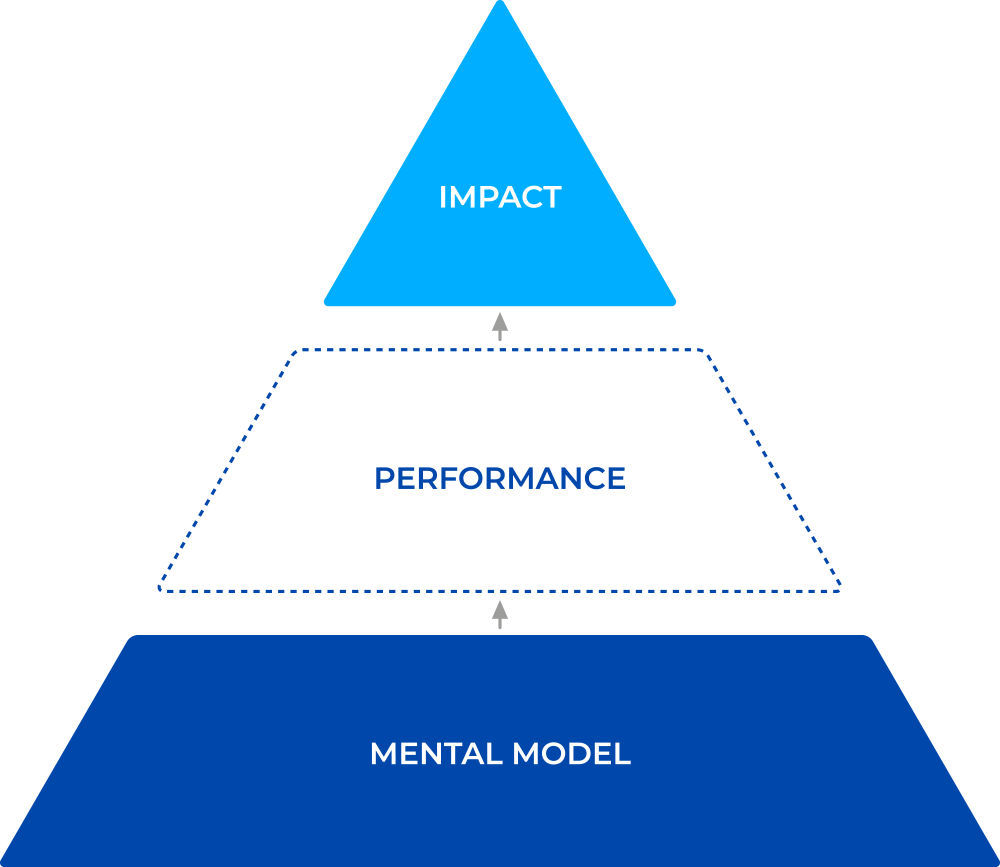
The impact that experts have is the contribution teachers and leaders make to pupil outcomes, be that in the classroom or across other indicators, the likelihood that pupils go on to further study or their longer term health and wellbeing for example.
The impact that expert teacher and leaders have is a result of their performance; what they see, think and do. Evidence suggests that there are things that teachers and leaders can do that will enable them to have greater impact on the children they work with.
We therefore want PD to attend to the mental models people hold about the work they do. In order for PD to do this effectively, there are four things we need to think about.
1. Draw upon what we know about how humans learn
Learning is hard. When it comes to learning, teachers (or leaders) are subject to many of the same challenges as pupils. They may lack motivation, they can be distracted, they can easily forget things and struggle to transfer learning from one content into another. Fortunately, we have a good evidence base about how pupils learn (for example, ensuring opportunities for retrieval practice and revisiting ideas over time) and we can also apply this evidence to teacher and leader development.
Any professional development we design should incorporate the features of effective teaching. It should be sequenced to ensure individuals can return to and continue to develop their understanding of a given domain, it should anticipate the misconceptions teachers or leaders may have, model concepts clearly, ensure opportunities to revisit content and provide useful feedback about progress.
2. Start with purpose
The central challenge that all teachers and leaders face is their ability to improve the learning and development of their pupils. This idea should guide all the decisions schools make about professional development. The purpose of teachers and school leaders’ work can be described through a series of ‘persistent problems’ – common challenges that they will always face within in their role. Teachers, for example, need to understand pupil motivation and use this understanding to shape their teaching. Heads of department need to build a coherent curriculum around their subject. Executive leaders need to be able to set and create the conditions for an effective culture across their trust. By focussing on what it is that individuals need to do in their work, we are more likely to be able to design and deliver professional development in ways that meet these needs.
3. Incorporate mechanisms which lead to behaviour change
Changing our behaviour is more difficult than it might sound. Research tells us that professional development often fails to make a lasting difference to individuals’ practice (Copur-Gencturk, 2014). One powerful reason for this is because habits – our automatic responses to specific stimuli – are very difficult to change, even when individuals set goals to change their behaviour. Teachers and leaders rely on deeply habitual behaviour to manage the often pressured or challenging environments they work in. These habits can be very difficult to change, even if the intention and desire to do so is present. By incorporating mechanisms into PD that support behaviour change, it is more likely that it (PD) will have impact (Sims, et al, 2021). A recent paper (Sims, et al, 2021) highlight such mechanisms, explaining that PD should:
- Manage individuals’ cognitive load and create opportunities to revisit prior learning
- Set goals which define the behaviour to be achieved through engaging in PD, be presented by an individual considered to be a credible source in favour of the desired behaviour and reinforce and reward effort or progress towards performing the behaviour
- Be clear about how the behaviour should be performed, provide practical social support (e.g. from colleagues or friends) relating to the performance of the desired behaviour, clearly demonstrate what the behaviour looks like when done well, monitor and provide feedback on the performance of the behaviour and provide opportunities to practice the behaviour away from the context within which it would usually be performed (e.g. away from the classroom / pupils)
- Introduce a cue or stimulus to which the behaviour would be linked, create opportunities to plan to deliver the behaviour (e.g. planning or scripting), establish a method for the individual to monitor and record the desired behaviour and create opportunities for rehearsal within the context so the context elicits the behaviour
4. Create the right conditions for professional development to take place
There is a danger that in focusing too much on the what and how of professional development we lose sight of the conditions within which it takes place, which research suggests are just as important (Kraft and Papay, 2014). The conditions in a school can lead to any PD related activity being viewed as developmental or threatening depending on how it is experienced. Professional development will be most effective in a school culture where the learner feels valued and trusted, and where the purpose of PD is clear and aligns with the individuals’ goals.
Securing the conditions for PD to be effective is so important that the third blog of the series is focussed on exploring just that.
Conclusion
Research suggests teachers spend approximately 10 days a year engaged in professional development. Across the teaching workforce, this equates to more than 5 million days. Being able to deliver CPD which has a good chance of impacting upon pupil learning is vital if this time (and cost) is to be worthwhile.
References
- Copur‐Gencturk, H., (2014). The effects of a master’s program on teachers’ science instruction: Results from classroom observations, teacher reports, and student surveys. Journal of research in science teaching, 51(2), pp.219–249.
- Fletcher-Wood, H., and Zuccollo, J., (2020) The effects of high quality professional development on teachers and students: A rapid review and meta-analysis.
- Wellcome Report, https://epi.org.uk/publications-and-research/effects-high-quality-professional-development/
- Hill, H., Beisiegel, M., & Jacob, R., (2013). Professional development research: consensus, crossroads, and challenges.
- Educational Researcher Institute of Education Sciences (2019) The effects of a principal professional development program focused on instructional leadership. https://ies.ed.gov/ncee/pubs/20200002/pdf/20200002.pdf
- Kraft, M.A., Blazar, D., Hogan, D., (2014). The effect of teaching coaching on instruction and achievement: A meta-analysis of the causal evidence. Review of Educational Research.
- Kraft, M.A. & Papay, J.P. (2014) Can supportive professional environments promote teacher development? Explaining heterogeneity in returns to teaching experience. Educational Evaluation and Policy Analysis.
- NCEE (2016) Does content-focused teacher professional development work? Findings from three Institute of Education Sciences Studies. NCEE Evaluation Brief. https://ies.ed.gov/ncee/pubs/20174010/pdf/20174010.pdf
- Sims, S & Fletcher-Wood, H., (2020) Identifying the characteristics of effective teacher professional development: a critical review. School Effectiveness and School Improvement