


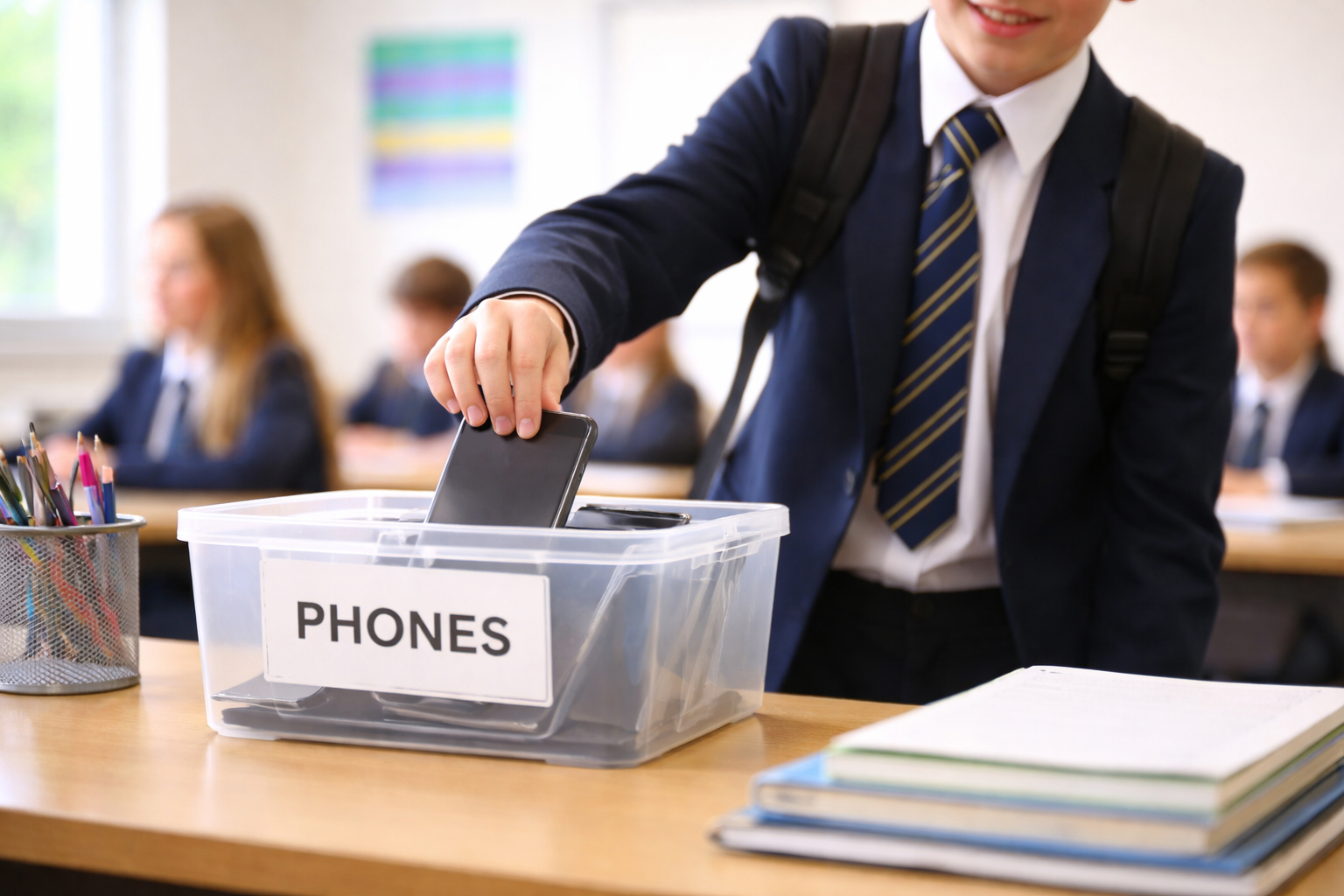
Dr Jen Barker, National Director of Learning, explores the growing debate around smartphones in schools and asks whether it is time to move towards phone-free environments to better support pupils’ learning, wellbeing and school experience.
Smartphones are ubiquitous. With more than 4.8 billion users worldwide (Turner, 2024), they are a fixture in our daily lives. Evidence suggests children are among the heaviest users of digital devices. Research shows that 8–12-year-olds spend an average of 5.5 hours a day on screens, rising to 8.5 hours for 13–18-year-olds (Rideout et al., 2022). Over half of 15–17-year-olds say they are online “constantly” (PEW, 2022).
With usage at such levels, educators and parents are beginning to ask questions about the impact of mobile phones and the content they enable access to, questions like: what impact do smartphones (and the content available on them) really have on children’s attention, their learning, mental health and wellbeing, and school life in general?
The debate: correlation or causation?
A central tension in the research is whether smartphones cause harm or whether the effects we see in children are correlated with other challenges. Some argue the focus on phones distracts from deeper issues driving the rise in mental health difficulties (Odgers, 2024; Warner, 2024). Others suggest that the evidence increasingly demonstrates direct, negative effects on children’s cognitive, social, and emotional outcomes.
Multiple studies suggest that even the presence of a phone on a desk can reduce concentration and recall.
Phones, attention and learning
Mccrea writes that learning should be viewed as ‘the process of paying attention to and thinking about something’ (Mccrea, 2025). Pupils’ attention is a precious commodity, and should be protected at all costs, so that it can be channelled towards the things we want pupils to learn. Multiple studies suggest that even the presence of a phone on a desk can reduce concentration and recall (Thornton, 2014; Tanil & Yong, 2020). In one experiment, students who did not use their phones during a lecture wrote down 62% more information and scored a grade and a half higher on a subsequent assessment than those who did (Kuznekoff & Titsworth, 2013).
The World Economic Forum has linked digital distraction to declining global test results, recommending schools limit device use (WEF, 2023). A large-scale study in Brazil found that for every 100 minutes of daily phone use, pupils slipped 6.3 places in school rankings, with the effect doubling when phones were used during lessons (Felisoni & Godoi, 2018).
On balance, although the evidence is not unanimous – some research highlights benefits when devices are carefully integrated into lessons – the risks of distraction by devices appear to outweigh any gains they might provide.
Phones and wellbeing
Mental health among young people is worsening, with one in five now experiencing a probable disorder (NHS Digital, 2023). While smartphones are likely to be only part of this picture, their role cannot be ignored. Excessive use of devices has been linked to poorer sleep, heightened anxiety, and reduced face-to-face social enjoyment (Dwyer, 2018).
The concept of “problematic smartphone use” (PSU) has even been compared to substance addiction, associated with impulsivity, low self-esteem, and poor emotional regulation (Sohn et al., 2019). Girls, in particular, appear more vulnerable: studies suggest they are more likely to experience concentration difficulties and lower psychological wellbeing linked to social media (Twenge & Martin, 2020).
Recent experimental evidence is especially striking. In one 2025 study, participants deprived of mobile internet for a month reported measurable improvements in attention, wellbeing, and mental health (Castelo et al., 2025). This points towards a causal link between device use and negative consequences for users.
Do phone bans work?
Several studies suggest that banning phones in schools boosts learning outcomes, especially for disadvantaged students. Research from the UK found GCSE scores rose after bans, with the biggest benefits for lower-achieving pupils (Beland & Murphy, 2015). Policy Exchange (2024) similarly found schools with stricter bans were twice as likely to be rated “outstanding.”
Not all evidence is aligned. Some studies, particularly in countries like Sweden where educational technology is more embedded, show no additional benefit from bans (Kessel et al., 2020). However, critics argue these findings often rely on self-reporting and inconsistent definitions of “restrictive” policies.
A precautionary principle
If we are wrong about the harms of phones, the worst-case scenario is that children spend more time playing, socialising, and listening to their teachers (Haidt, 2024). But if we are right, the costs – in learning loss, inequality, and wellbeing – are “almost incalculable.”
With mounting evidence of distraction, inequity, and potential mental health risks, the impetus to move towards a ban is increasingly significant. While not the whole solution, creating phone-free environments (especially at stricter levels where pupils are separated from their phone for the duration of the school day) are likely to be one of the simplest, most cost-effective ways to protect both learning and wellbeing.
Any form of technology is only likely to be effective when it aligns with evidence about effective teaching and what we know about how humans learn. The balance of evidence suggests that when it comes to use of phones in schools, less is likely to be more.
For a more in-depth review of the literature on mobile phones – take a look at our literature review.